
Central midfield is where the heartbeat lies within Reggina’s side. Great emphasis is placed upon the passing and vision attributes, looking to unpick the locks of deep-lying defensive tactics that opposition managers utilise to try to nullify their attacking strength. Whilst the Reggina style of play involves fast attacks, countering quickly with players encouraged to express themselves and run at the defence, this is not always possible. Where possession is slower, which can often be the case against the defensive tactics employed by other Serie A teams against them, the central midfield pairing are key components in the tactical set-up.
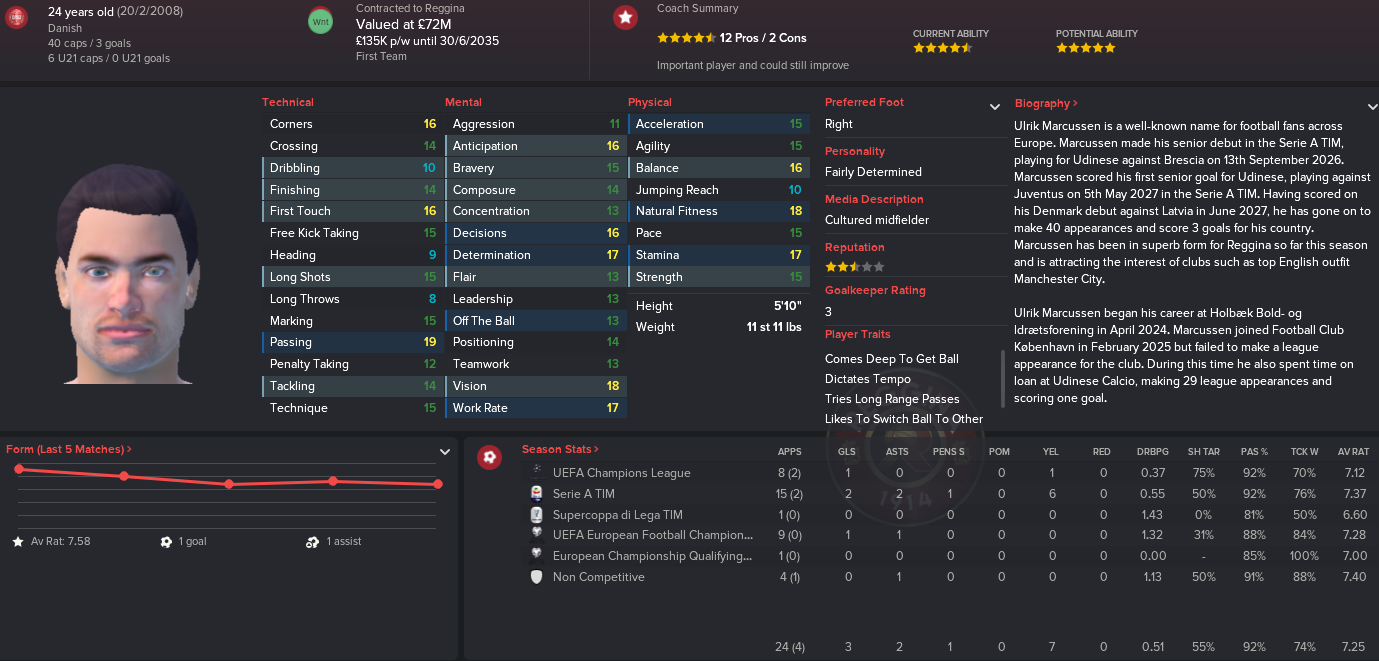
Ulrik Marcussen is a Danish maestro, signed from FC København. He was loaned out to develop whilst other central midfielders impeded his player development path at Reggina. After heading out on loans at Udinese and Burnley designed to provide him with first team action, the latter loan was cut short after an injury to a senior player at Reggina. Marcussen found his chance and he hasn’t looked back since. Subject to a recent £140m bid from Man City, a would-be world record fee, Marcussen is a truly all-round gifted player.
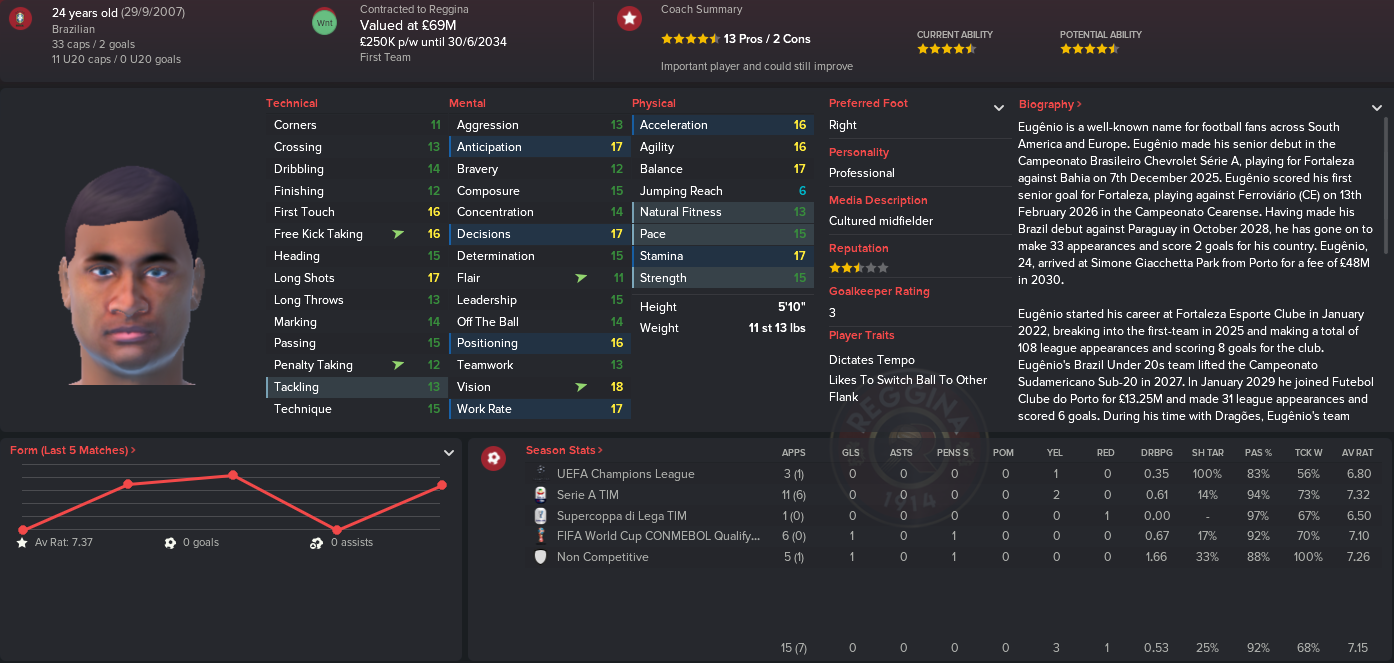
Eugênio joined Reggina three years ago, coming in from Porto for a minimum fee release clause of £48m. Unable to be registered in his first year due to non-EU player limits, Eugênio looks to be making up for lost time in stamping his abilities upon Serie A and for his home country, Brazil. Manchester United have been rumoured to be interested in signing the ex-Fortaleza player ever since he arrived at Amaranto’s Stadio Simone Giacchetta Park.
Raúl Mugabure, an Argentinian international, has been with Reggina for only two years, also fell foul of the non-EU player limits in his first season – leading to a short-term loan to Bundesliga side, RB Leipzig, to prevent stagnation and risking him becoming unhappy. A Club Atlético River Plate graduate, he made a solid start to his River career, making 162 league appearances before joining Amaranto, and has represented his country twenty-three times. An £86m offer is on the table from Manchester City and looks likely to be accepted to make space in the squad for younger prospects to be registered for the League.

The right-side of the central pairing is set as a deep-lying playmaker on defend, regardless of player selection. This role offers solidity and balance to the right-hand flank, as the full back on that side looks to drive forwards and create overloads. Hanging back in space away from the attack also means that ball recycled if a teammate is unable to see an incisive pass or a cross isn’t on. They look to allow teammates on the flanks do the running, with Marcussen (0.51 dribbles/game) and Eugênio (0.53 dribbles/game) covering their >13km/90m by finding space and tracking back and forth as the play transpires around them.
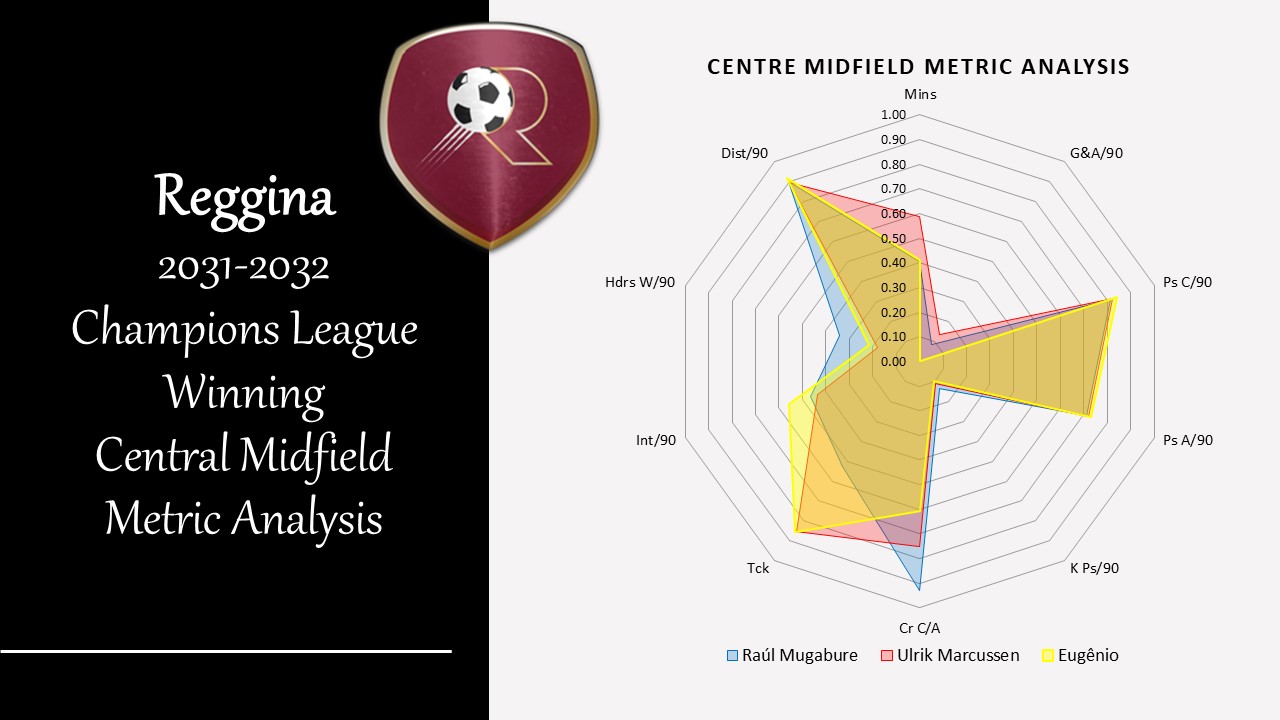
Simple, short passes are typically the order of the day, despite these three players possessing top-level passing and vision attributes and the team’s instructions to pass into space. This is most recognisable in their high passing completion stats, with all players who have played in this role having a pass completion percentage equal to a remarkable 92%. Given the short nature of these passes, they aren’t defence-splitting/key passes, and so their assist numbers are very low – with only two assists, both claimed by Marcussen, who is listed as a corner taker, in a cumulative 4,599 minutes across all three players.
Instead, greater emphasis is placed upon their defensive capabilities, looking for them to win interceptions with their reading of the game and complete tackles to disrupt the play of the opposition. Dropping deeper, acting as a shield for the defence when in possession, allows the player to be ready to act when the opposition win the ball back and either look to launch a quick counter or clear the ball long. Its telling that their respective tackle completions per game are above that of any central defender, with Eugênio (4.08 tackles/match) and Marcussen (4.06 t/m) ranking third and fourth behind only the left full back pairing of Werner and Pasquale (Mugabure is seventh with 2.52). With this role breaking up opponents play before it reaches the final line of defence helps to explain why Reggina only conceded thirty-seven goals throughout the fifty-four game season.
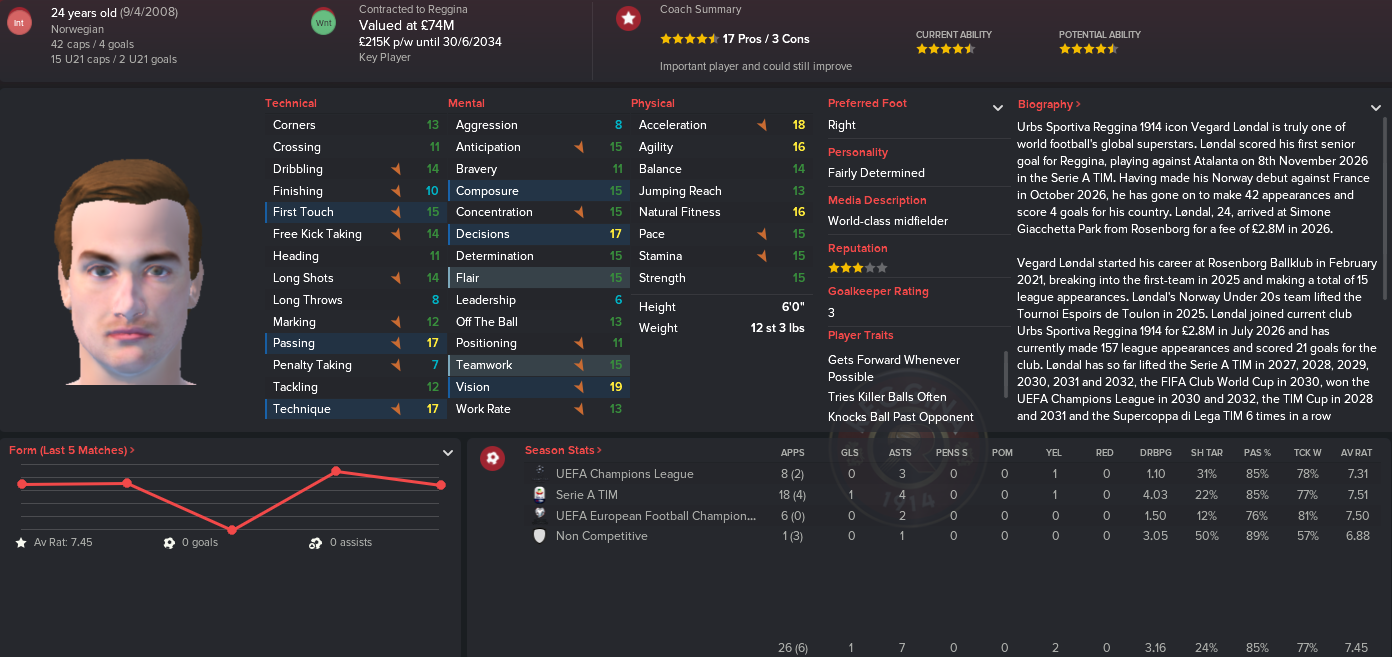
Contrastingly, the left-hand side of the pairing is not locked in terms of player role. Vegard Løndal, a Norwegian master player-maker, slots into the team as an advanced playmaker on support to provide a more advanced creative role, to dribble at opponents exploiting his pace and acceleration to panic them and then look to exploit the gaps that are opened up with a well-judged pass to a teammate. Signed for a meagre £2.8m from Rosenborg, the world-class midfielder has remained with Reggina ever since – his player pathway left open for him to come through after his predecessors were sold on. With every key attribute for the advanced playmaker position being above 15, Løndal is almost peerless in world football.
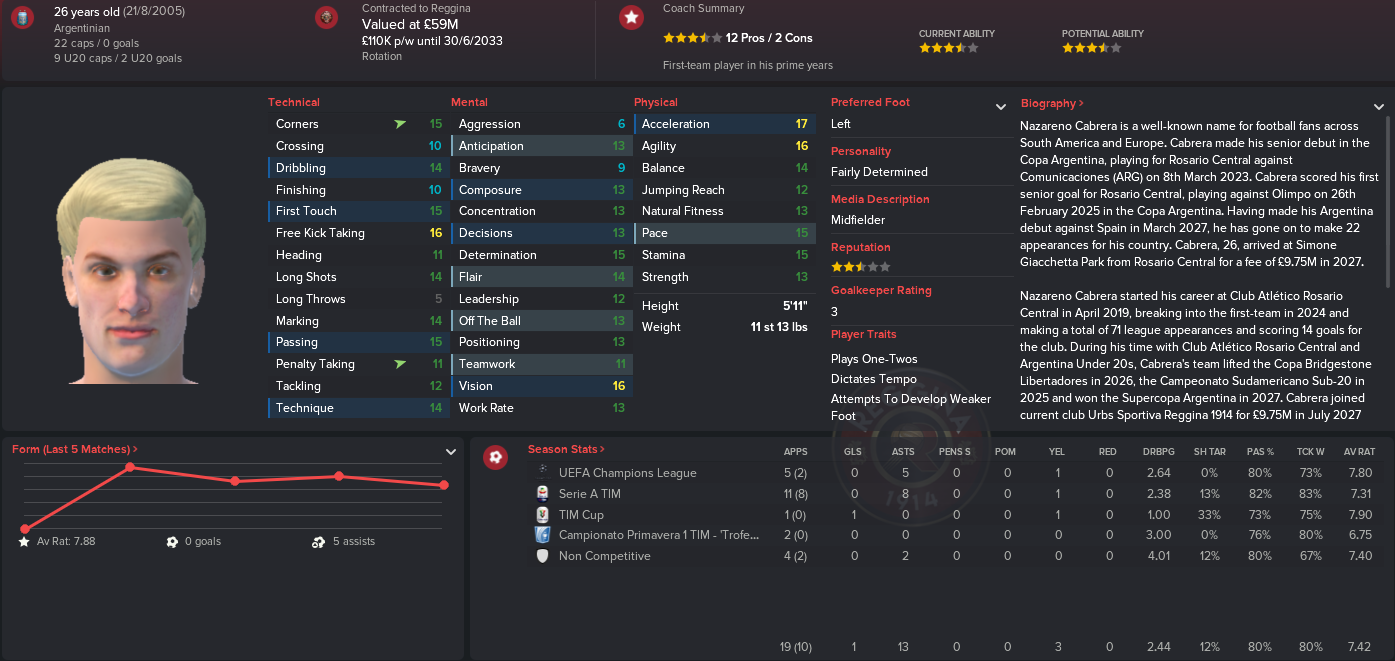
Nazareno Cabrera also adopts the central advanced playmaker role, but prefers to be more attacking in his play, taking up a more progressive position. The £9.5m signing from Rosario Central, Cabrera played a key role in the Champions League win, providing an impressive five assists in five games. Being naturally left-footed and playing on the left, Cabrera enjoys linking up with the winger outside of him or playing passes through to the attacking midfielder or compete forward.
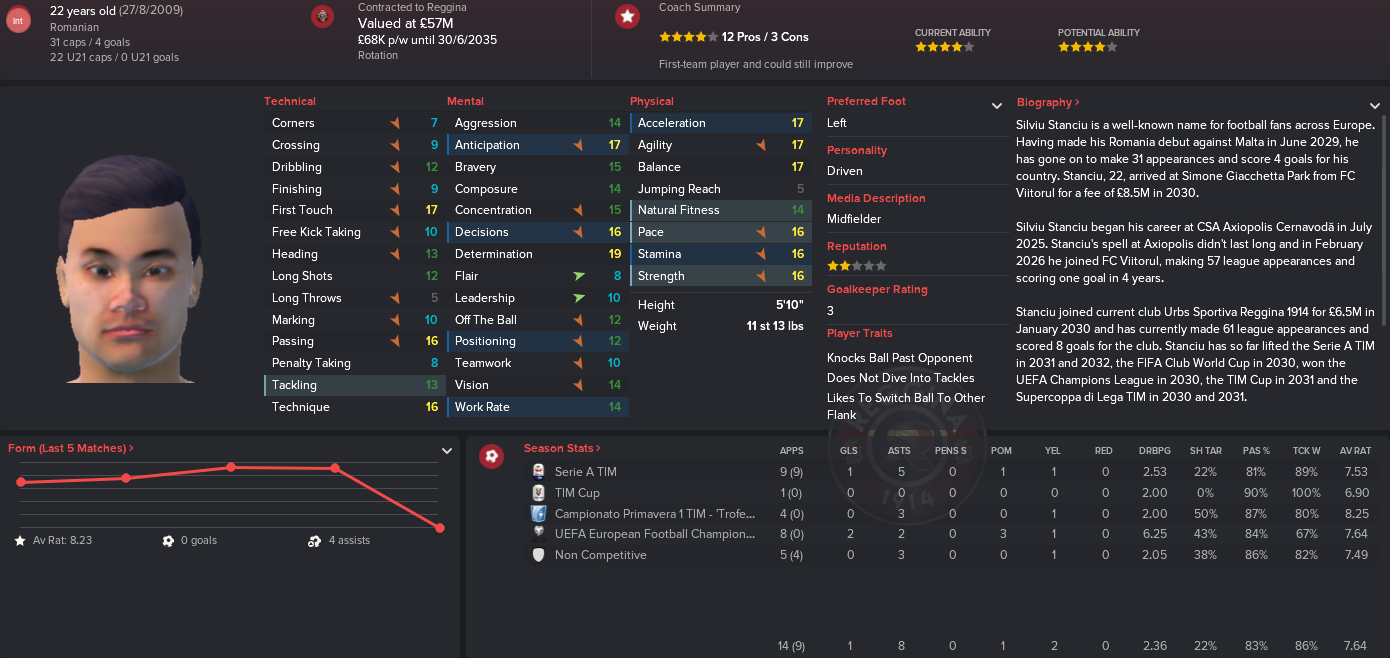
Romanian, Silviu Stanciu provides a back-up option to Løndal and Cabrera. His physicality is a major proponent of his game and helps to explain the switch in the role to box-to-box midfielder when he takes to the field. Providing dangerous penetrating runs into the opposition box, Stanciu has the ability to unlock opposition defences before laying off the final pass for an on-running forward to slot home. An £8.5m signing from FC Vitorul, Stanciu is ready to come off the bench to use his combination of his physical attributes and technical ability.
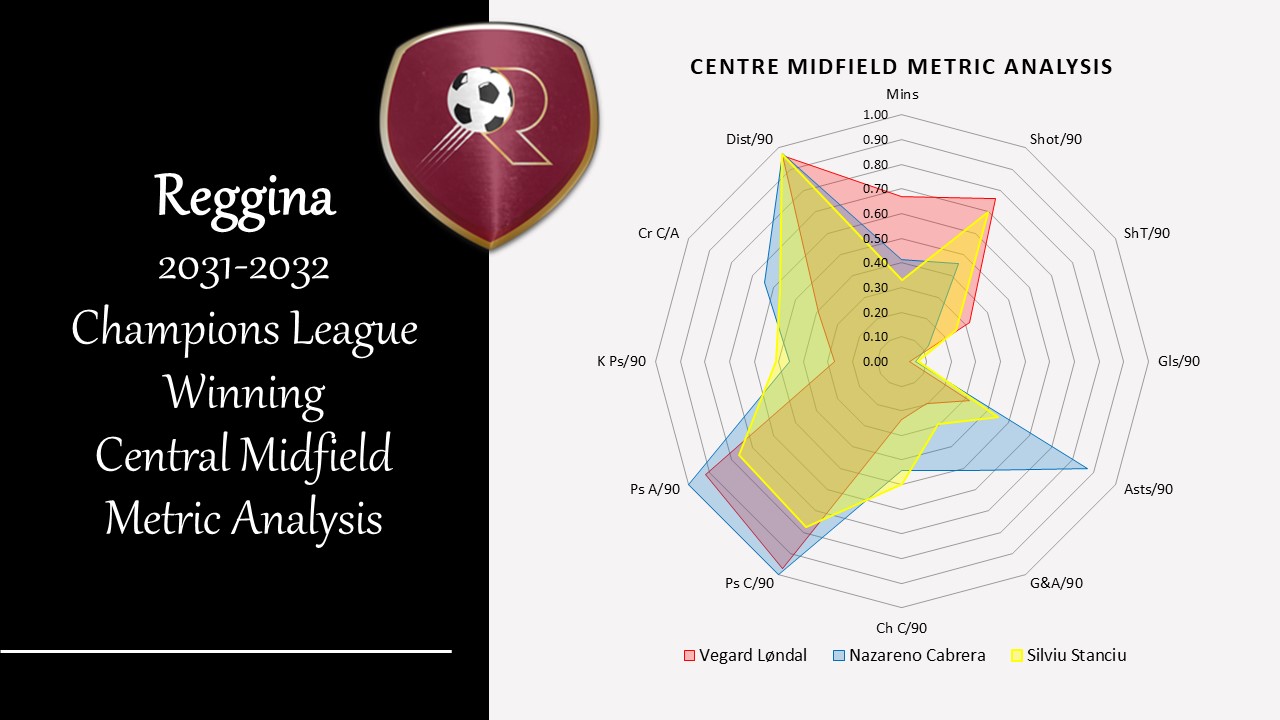
The differing roles that these players fulfil on the left-hand side can easily be identified, especially with Stanciu attempting/completing fewer passes. Yet all cover the same distance/90mins – a remarkable 14km/game, with only one player topping this metric ahead of them. None of these players are goal scorers, with just three goals between them (one apiece – more detail on this in below) and together they fill the top three places for the passes attempted/90mins metric.
The lack of goals from this position in the team merits further investigation – all players in this position shoot too frequently given their poor pay-off returns in terms of goal/shot. Løndal (3.41 shots/90mins), Cabrera (2.05 sh/90mins) and Stanciu (3.14 sh/90mins) all have poor shot accuracy – 0.82, 0.33 and 0.66 shots on target/90mins respectively. When assessed alongside their goals/90mins, all players have below 0.08 goals/match. Deeper analysis of Londal’s metrics show that of the eighty-three shots he attempted over the course of the 2031-32 season, he scored just 1.20% of them – one goal – a truly damning metric. This clearly demonstrates he, and others in this position should look to use the ball more efficiently, instead creating chances later on in the phase of play through maintaining possession, rather than shooting from distance when an initial attacking phase has stalled. These metrics are also rather curious given that, for both Cabrera and Løndal, the advanced playmaker role come with shoot less often and that the team are instructed to work the ball into the box.
The starkest of the metric analysis here, if the above metric isn’t disastrous enough, focusses again on Løndal. One would expect Løndal, anointed playmaker-in-chief, to be contributing more key passes/90mins, especially given his ‘tries killer balls often’ player trait and high level passing and vision attributes. Yet, Løndal’s key passes/90mins is markedly lower than his two inter-squad rivals for that position. His 1.52 KP/90mins is one whole key pass per 90mins lower than both Cabrera and Stanciu. This is both equally surprising and concerning. Løndal’s lower assists/90mins – 0.29 A/90mins against 0.79 A/90mins and 0.41 A/90mins – could partially be understood through Løndal playing in ‘tougher’ Serie A games where Reggina see lower possession figures, but to have a metric this markedly different to others is alarmingly startling. This helps to explain why later in the season Cabrera became the go-to-selection – weighing in with thirteen assists in only sixteen starts (ten appearances more from the bench). Cabrera’s corner taking in the Reggina side may skew the metrics, so this requires more detailed assessment to strip out set-piece contributions, but this is something to keep an eye on in future, should Løndal remain with Reggina.
The constituents of Løndal’s player traits ‘runs with ball often’ and ‘knocks ball past opponents’ is highlighted by his high dribbles per game metric – successfully completing 3.2 per game, with only wingers outstripping his efforts. However, if he isn’t delivering passes successfully into goal-creating areas, then this means very little. Progressions in the form of dribbles which are destructive aren’t especially useful if they end up in a turn over or long shot with a low xG and shot accuracy likelihood.
Perhaps his impressive attributes could be better utilised playing under a different role going forwards, so that his dribbling prowess and ability to progress the ball in this way can be better utilised to unlock defences with movement around him from other roles. This may require further investigation into the 2032/33 season.
Below shows the full metrics available for all six players analysed above for your own perusal/conclusions:

Many thanks for sharing your work, this is both interesting and useful! I’ve got it working in FM24 and have…
Thanks for sharing. Love the design.
The post is now live: https://afmoldtimer.home.blog/2025/06/14/the-art-of-the-artwork/
much appreciated if it is not too much effort. I already have a load of data exported with lookups and…
That’s easy enough to create. I’ll do a blog explaining how to do it if you like? You’ll need a…


-

Bundesliga 2044-45 – The One That No-One Wanted to Win
There were times when this should have been a formality and others when it was barely in reach. And yet, here we are; Bayer 04 are Bundesliga champions for the fifteenth time in a row. A 2-0 victory away to SC Freiburg wouldn’t have mattered had Hansa Rostock been able to beat 1. FC Köln.… Read more
-

Bayer Leverkusen 2043-44 – Domestic dominance, defensive brilliance or downright luck?
After winning the Bundesliga for the fourteenth (14th) year in a row, by a total of 12 points, I wanted to see how dominant we’d become over the course of this season to get a sense of how far ahead of the rest of the league we are. Sure the points difference tells a story,… Read more
-

The Art of… The Artwork
I’ve had requests from a few people to show how to make the graphics I use for various aspects of my blogs. In particular, the squad age against minutes, overall minutes across the squad by position and age profile against peak age. In this blog post, I’ll take you through how to extract the data… Read more
-

Liverpool Matters – Summer 2025 Squad Analysis & Transfers
Moving on from a club legend Liverpool probably couldn’t have hoped for a better season. For Slot to come in to replace a club icon in the form of Klopp, who left after nine years in charge after reinvigorating the club, alongside FSG, into what became largely his image after Michael Edwards left, and to… Read more


 A FM Old Timer
Leave a comment